Visual guide
Urgent vs important
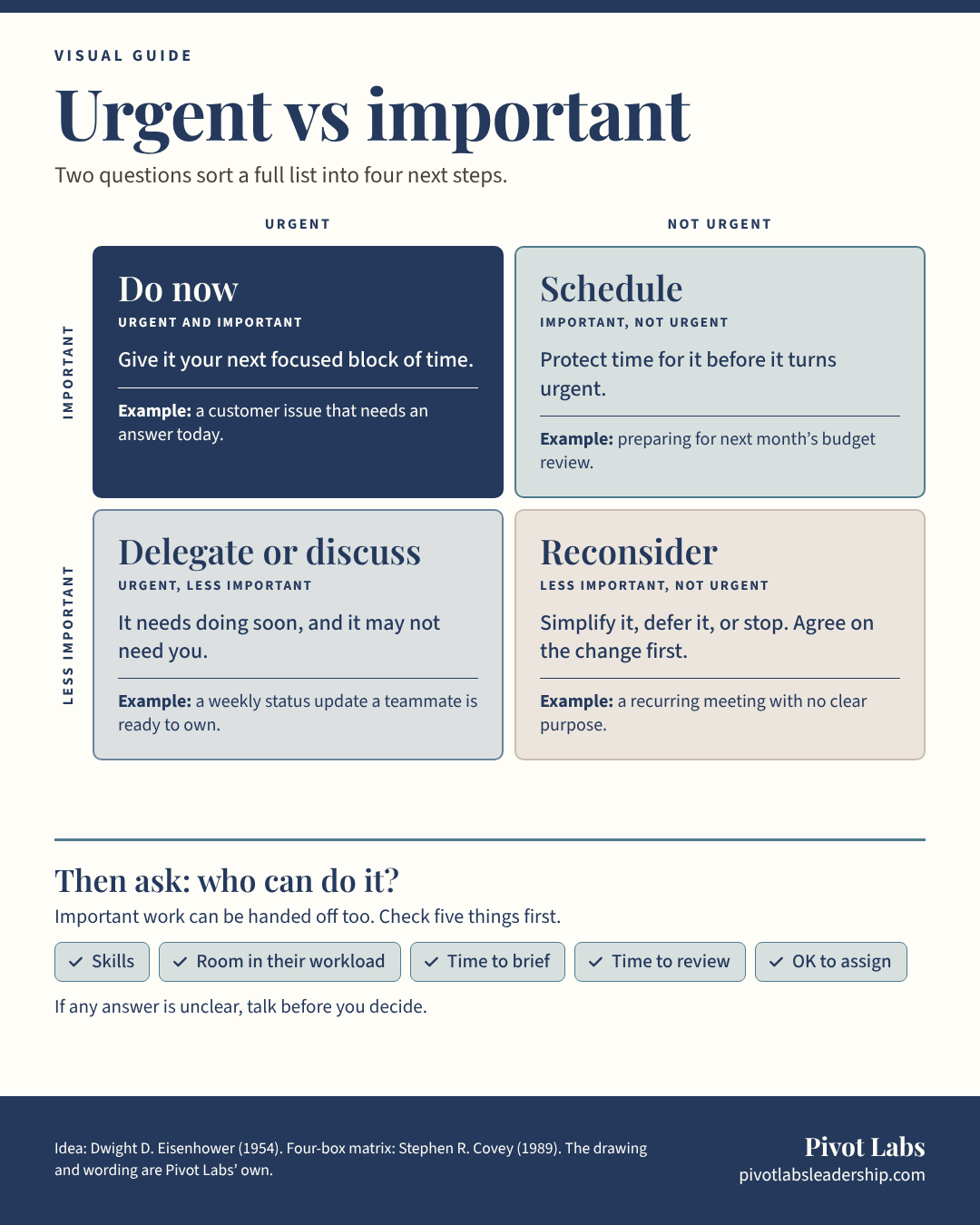
Urgent work has a deadline close by. Important work moves something that matters. They are not always the same work. Two questions sort a full list into four next steps.
Two questions
Ask them one at a time, because the answers can differ.
Is it urgent?
Something happens soon if it waits. A deadline passes, someone is left waiting, or a problem grows.
Is it important?
It is required, already promised, or tied to an outcome that matters.
Urgent work asks for attention on its own. Important work often does not, so it needs a place on your calendar.
Four next steps
Put the two answers together and each task lands in one of four boxes. Each box suggests a next step. Move a task when things change.
Example: one manager’s Monday list
Do now
Urgent and important
Give it your next focused block of time.
Example: a customer issue that needs an answer today.
Schedule
Important, not urgent
Protect time for it before it turns urgent.
Example: preparing for next month’s budget review.
Delegate or discuss
Urgent, less important
It needs doing soon, and it may not need you.
Example: a weekly status update a teammate is ready to own.
Reconsider
Less important, not urgent
Simplify it, defer it, or stop. Agree on the change first.
Example: a recurring meeting with no clear purpose.
A third question: who can do it?
The grid can make it look as if only less important work gets handed off. Important work can be handed off too, when the handoff is workable. Check five things first.
- Someone has the skills for it.
- They have room in their workload.
- There is time to brief them and for them to do the work.
- There is time to review it and make corrections.
- You have the OK to assign it.
If any answer is unclear
Talk before you decide. The current owner keeps the work until a handoff is agreed.
Three things to watch
Schedule gets skipped
Nothing forces this work onto your calendar. When it keeps waiting, it tends to show up later under Do now.
Reconsider is a question
Someone may rely on the work. Agree on the change with them before you simplify it, defer it, or stop.
The same fire keeps coming back
A task that returns to Do now week after week has a cause worth finding. See the guide Find the real cause.
The Eisenhower Matrix lets you add your own tasks. It asks about timing, value, and who can do the work, then suggests where each task goes. You can print the result.
About this guide
This guide is a one-page picture of the idea behind the Eisenhower Matrix. The idea of separating urgent work from important work comes from a 1954 speech by Dwight D. Eisenhower. Stephen R. Covey turned it into a four-box matrix in The 7 Habits of Highly Effective People (1989). The third question, who can do the work, is the Pivot Labs addition. The drawing and wording are Pivot Labs’ own.
Sources: Covey, S. R. (1989). The 7 habits of highly effective people. Simon & Schuster. · Eisenhower, D. D. (1954, August 19). Address at the Second Assembly of the World Council of Churches, Evanston, Illinois. The American Presidency Project.